
B2B e-commerce: when Shopify or PrestaShop are no longer enoughWhen B2B e-commerce no longer fits a standard online store
Your trade customers still order by email or phone, even though you have a website. It is not a question of willingness: often, the site simply cannot sell the way you sell.
B2B e-commerce (selling online between businesses) becomes “complex” as soon as customers do not all buy at the same price, from the same catalogue or in the same way: negotiated prices, products on quote, several buyers per customer, several sites or brands, orders to synchronise with the ERP. Standard online stores handle simple selling well; beyond that, you need a foundation designed for business customer relationships.
Trade customers who order by emailThe situation: a website online, orders by email
The scenario is common among industrial and distribution SMEs and mid-sized companies. The company has invested in an e-commerce site. Consumers use it. But trade customers, who account for most of the revenue, keep emailing their sales rep, calling the branch or sending back a scanned purchase order.
The consequences quietly pile up:
- sales reps and sales administration re-key orders;
- reference or price errors creep in during re-keying;
- customers depend on their contact being available to place an order;
- no one has a complete view of what the customer has requested, been quoted and ordered.
Why trade customers bypass the websiteWhy business customers bypass the website
A business customer does not come to browse a catalogue. They come to order what they need quickly, on the terms they have negotiated. If the site shows them a public price, a catalogue that is not theirs, or makes them start from scratch on every visit, they pick up the phone again. That is rational: emailing their sales rep is still simpler than using the site.
In other words, your customers go where things are simple. The job is to make sure that is with you, online.
Shopify, PrestaShop, Magento and B2B e-commerceWhat standard e-commerce solutions do well
Shopify, PrestaShop, WooCommerce and similar platforms are excellent tools for what they were designed for: presenting a catalogue, taking payments, running a consumer checkout. Many also offer modules or extensions for trade customers. For a store that works in a standard way, they are a very good fit, and it would be a shame to do without them.
The limits of a standard online storeWhen the limits appear
Difficulties arise when several of these needs add up:
- customer-specific pricing or network-specific pricing, with contractual discounts;
- a different catalogue for each customer: not everyone sees, or is allowed to buy, the same products;
- products on quote: customisation, unusual quantities, options to be assessed;
- several buyers at the same customer, with different permissions;
- several sites: consumer and Pro, several brands, several markets;
- field sales reps who need to order on behalf of their customers;
- tight integration with the ERP, where items, customers and orders live.
Each of these needs can be handled with a module. Together, they produce a patchwork of building blocks that has to be held together, updated and synchronised. This is often where B2B e-commerce projects get bogged down.
An effective B2B e-commerce platformThe target setup
B2B e-commerce that works looks like this:
- The customer logs in
- They see their catalogue and prices
- They order or request a quote
- The sales rep steps in if needed
- The order goes to picking
- The customer finds their documents
On the company side, all orders, whatever the channel, arrive in one place, and the IT systems remain the reference for items, customers and invoicing.
A manufacturer, its dealers and consumersA concrete example
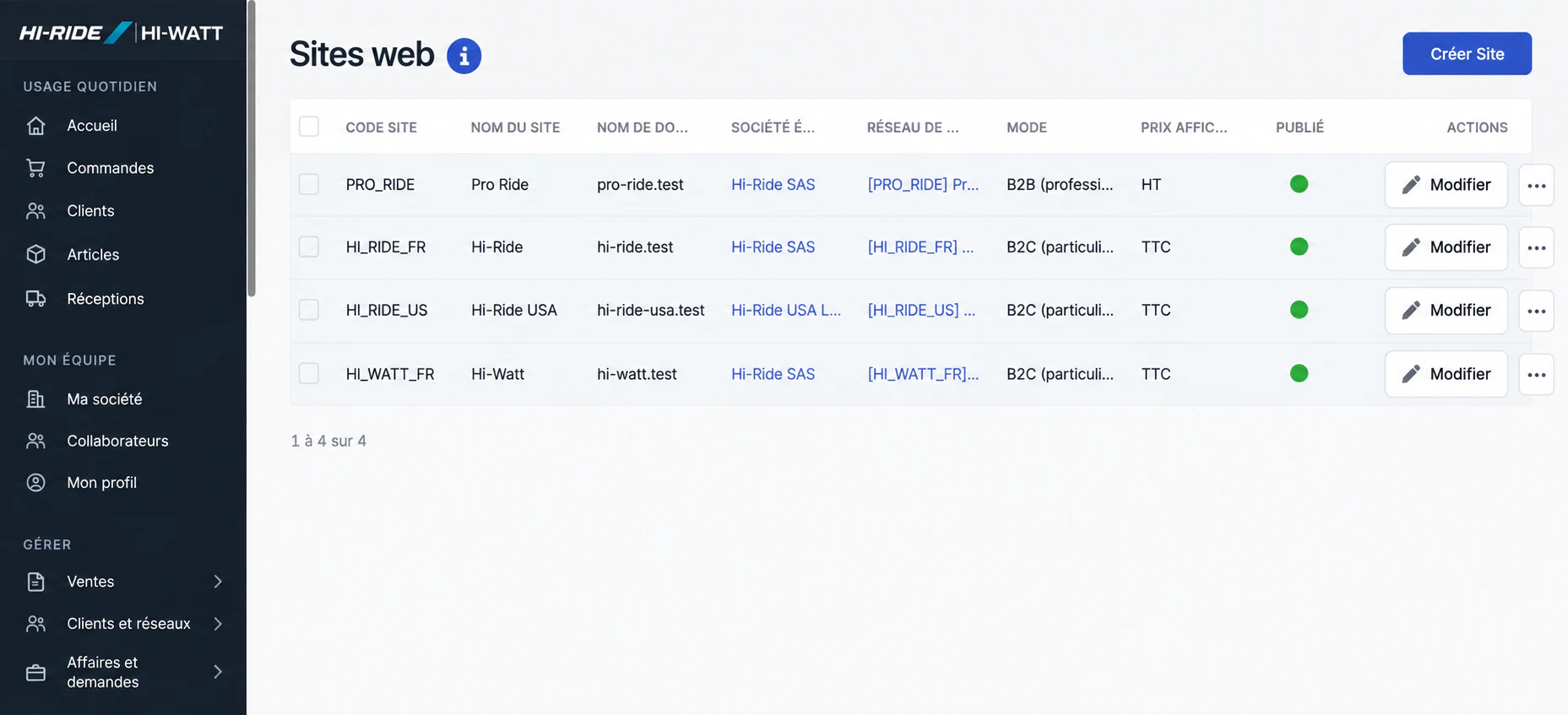
Our demonstration features Pro-Ride, a fictitious manufacturer of e-bikes, parts and batteries, and Claire, who runs a bike shop and is a Pro-Ride customer. From the same DRM, Pro-Ride publishes a trade area with prices excluding VAT and consumer sites by brand and by market, with prices including VAT.
Claire logs in to her Pro area: she finds her prices, her current basket, her orders and her usual products. She orders a battery at the catalogue price and, in the same basket, requests a quote for a custom paint job, attaching her mock-up. At headquarters, the sales rep receives the request with its context, prices it and sends the quote. Follow Claire’s full journey.
B2B e-commerce and customer relationshipsWhat the DRM brings
Hi-perf DRM was designed for these situations. Rather than adding B2B building blocks to an online store, it starts from the customer relationship:
- Their catalogue, their pricesEach customer sees their own terms as soon as they log in.
- From basket to quoteThe basket can become a quote request, and the quote an order.
- The customer’s organisationTeam members, orders, baskets and invoices in their own area.
- The field sales repThe same interface, to order on behalf of their customers.
- Several sites, one foundationPro, consumer, brands and markets published from the same DRM.
- Centralised ordersAll channels arrive in one place, then are picked and tracked.
Connecting B2B e-commerce to your ERPIntegration and constraints
The DRM can run standalone or be synchronised with your ERP, CRM and electronic invoicing. The scope of exchanges is defined project by project, based on your tools and what they can expose. Hi-perf has long experience of ERP integration, Sage X3 in particular, as well as data exchange via API or EDI.
One point to watch: B2B e-commerce only gets used if the data is accurate. The quality of the catalogue and customer terms is the first workstream, before any interface question.
B2B e-commerceFrequently asked questions
Do we need to abandon our current e-commerce site?
Not necessarily. If your consumer store works well, the question is mainly about B2B selling. Scoping your needs is precisely about determining what should go through the DRM and what can stay as it is.
Is the DRM suitable for selling only to trade customers?
Yes. A DRM can publish just a Pro area. The option to also publish consumer sites is there if you need it, not an obligation.
How are business customers onboarded?
The customer receives access to their area, where they find their prices and terms. The main account then adds its own team members and sets their permissions.
Are your trade customers still ordering by email?
Tell us about your channels, your customers and your tools. We will tell you what the DRM can take on.