
B2B customer portal and B2B e-commerce: featuresDRM Demand Relationship Management
Publish your sales channels, manage your customer relationships, orchestrate your logistics. What the Hi-perf DRM does, who it is for, and how it fits into your IT systems.
- Catalogue and pricingBy customer, network or market
- Baskets, quotes, ordersMultiple baskets, quotes, reorders
- Customers and permissionsCompanies, users, roles
- DocumentsQuotes, orders, invoices
- OperationsPicking, stock, shipping
- Sales forceAssisted selling, customer follow-up
- After-salesAfter-sales requests
- Customer engagementSegmentation, content, emailing
- Signals and managementRecurrence, unconverted quotes
- IT and AI integrationERP, CRM, WMS, MCP
What is Demand Relationship Management?A customer-facing and operational platform
The Hi-perf DRM is a Demand Relationship Management platform designed for companies whose sales channels, pricing, products or processes go beyond what standard e-commerce can handle. It lets you publish several customer experiences, manage quotes and orders, give customers and sales reps autonomy, orchestrate certain operations and integrate with the ERP, CRM, WMS and existing IT systems.
It brings together, on a single foundation, sales channels, customer relationships, quotes and orders, customer areas, sales-related operations, assisted selling and data flows with your IT systems. Depending on your architecture, it can be used:
- as a standalone platform
- as a customer layer on top of an ERP
- alongside a CRM
- connected to a WMS
- fed by an existing PIM or DMS
- as a multi-site, multi-brand, multi-network foundation
The DRM fits into your IT systems and replaces only what needs replacing.
In the software world, the acronym DRM often refers to Digital Rights Management. Here, DRM stands for Demand Relationship Management.
Orders by email, customer-specific pricingThe situations it addresses
- Orders still come in by email or phoneDespite the ERP, the CRM and the website: re-keying, errors, delays and dependence on your teams.
- Prices and catalogues differ for each customerNegotiated prices, networks, subsidiaries, discounts, payment terms, countries, currencies.
- Products are technical or configurableThe right part number, the right variant, the right compatibility: business rules built into the journey.
- Selling requires adviceBasket, question, quote, review by the sales rep, approval, order.
- Customers often order the same thingsPast purchases at hand, saved baskets, repeat orders, usual products.
- The company keeps adding channelsConsumers, Pro area, brands, subsidiaries, countries, distributors, sales reps, marketplaces.
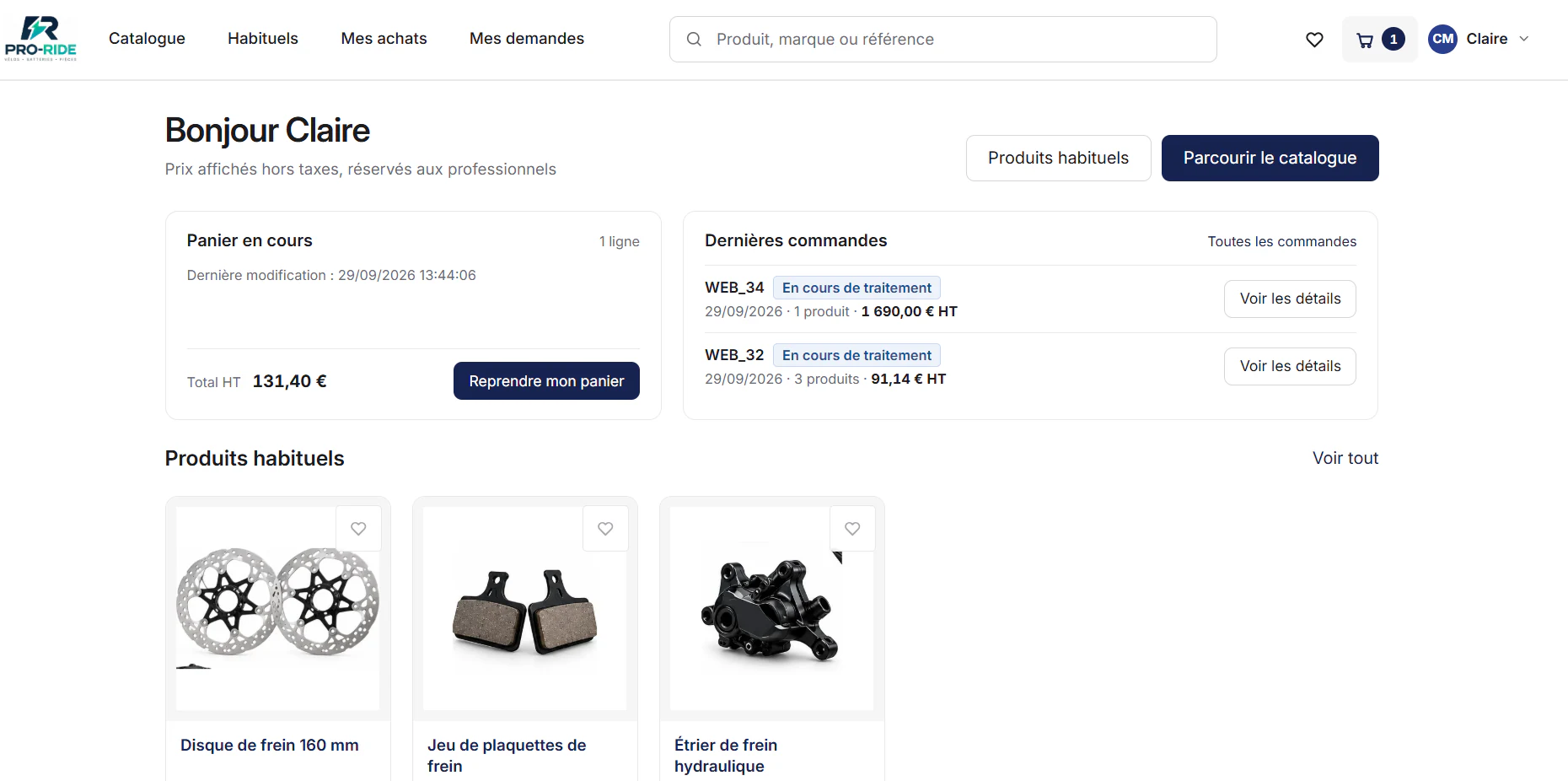
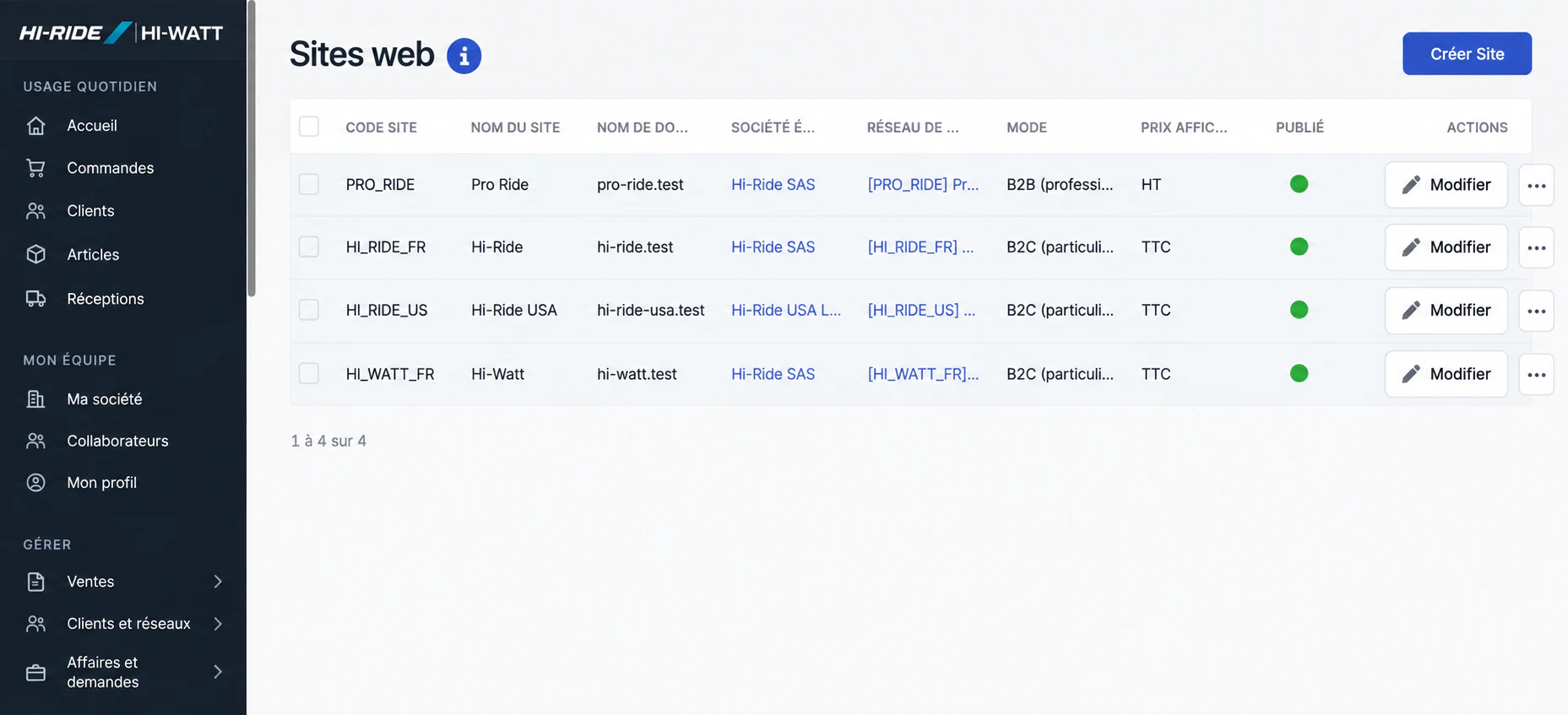
Consumer store, B2B portal, multi-brandSeveral experiences. One foundation.
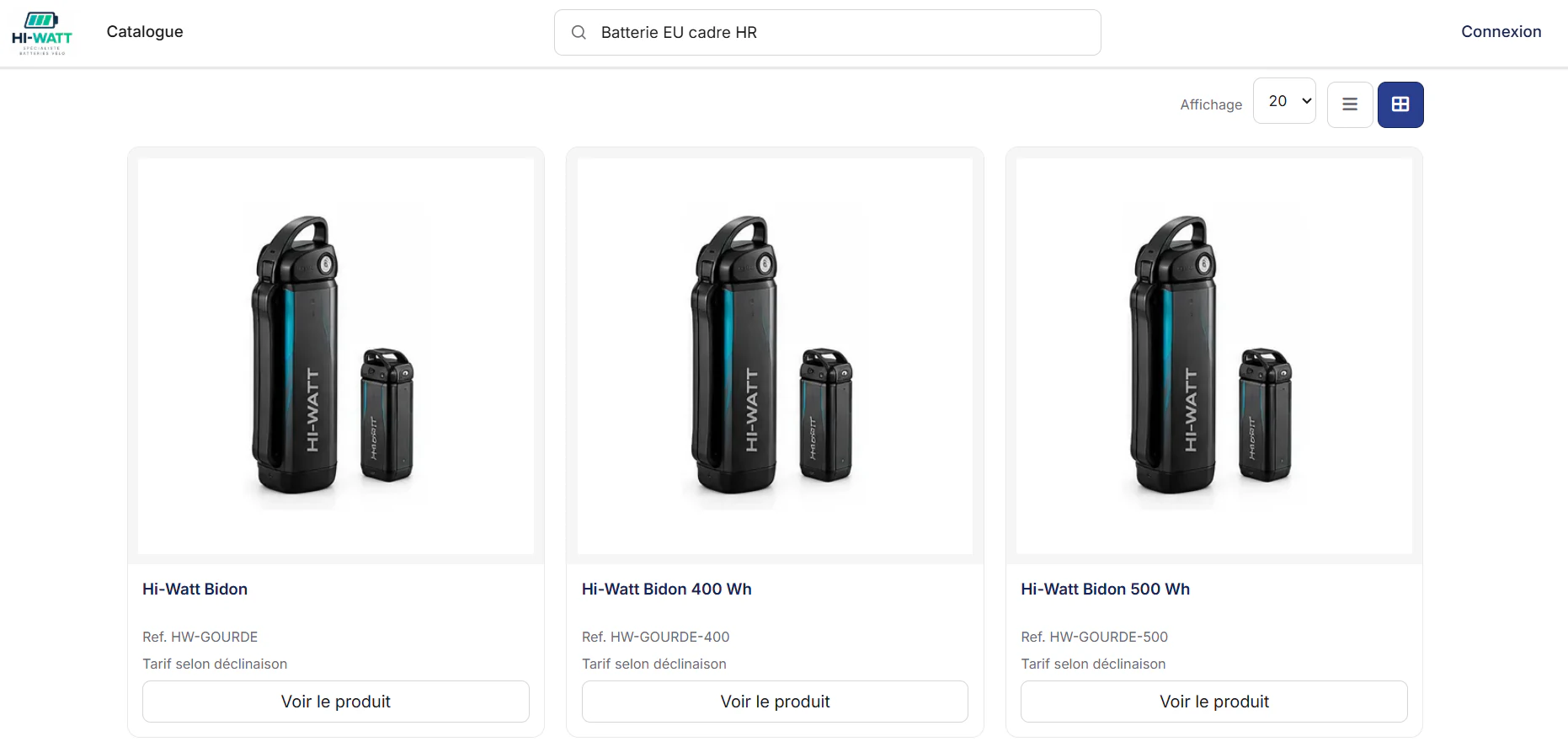
Each experience has its own catalogue, prices and rules; all of them run on the same DRM.
Marketplaces. The DRM can be connected to marketplaces (Amazon, ManoMano, Leroy Merlin, Fnac Darty or industry-specific marketplaces). This is a specific scope: it depends on each marketplace’s APIs and rules, your account, the categories and data flows required, and sometimes a specialist aggregator. It is assessed case by case.
Catalogue, customer pricing, quotes, orders, after-salesFeatures, by family
Expand a family to browse it. The exact configuration is defined with you during scoping.
Catalogue and pricingPublish and use the catalogue in every journey
- Items, families, categories
- Simple products, variants, options, bundles
- Configurable or complex products, compatibility
- Product media and documents
- Catalogue and authorised products by customer or network
- Prices by customer, network or market
- Discounts and commercial terms
- Languages, currencies, tax rules
The DRM is not meant to replace a full PIM: if you have one, it can feed the DRM.
Baskets, quotes and ordersFrom need to order, with or without a sales rep
Baskets
- Several active baskets in parallel: by site, by branch, by project
- Saved baskets, favourites, usual products
- Merging several baskets into one order
- Reordering a basket or a past order
Quotes
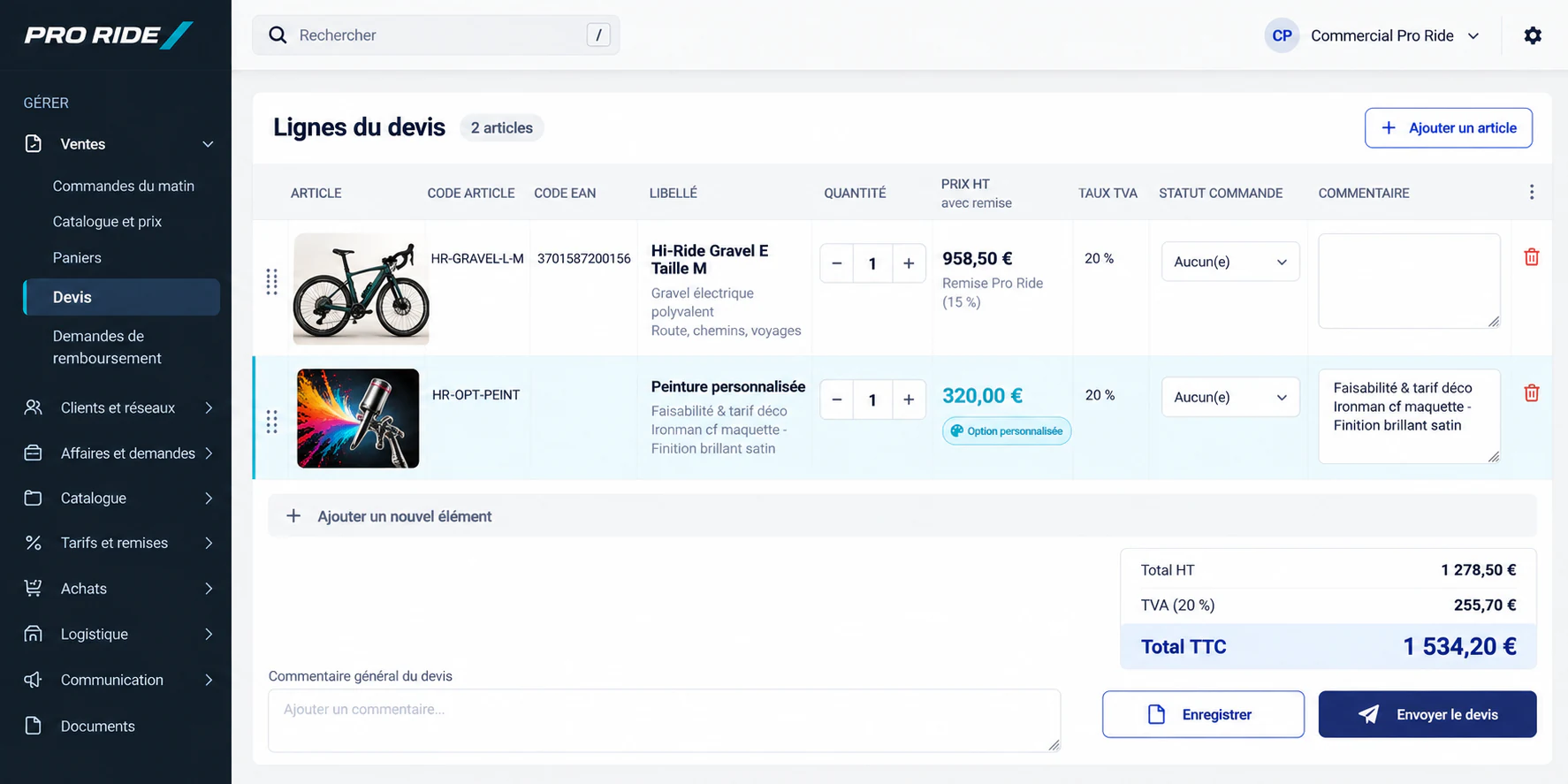
- Turn a basket into a quote request
- Add a question, attach a document
- Review by the sales rep: change a part number, adjust a line, add a condition
- Send the quote back, convert it into an order
Orders
- Direct order or order from a quote
- Created by the customer, with the sales rep or from a team member’s basket
- History, status, tracking
Customers, accounts and permissionsMirror your customers’ real organisation
- Company accounts, sites, subsidiaries, contacts
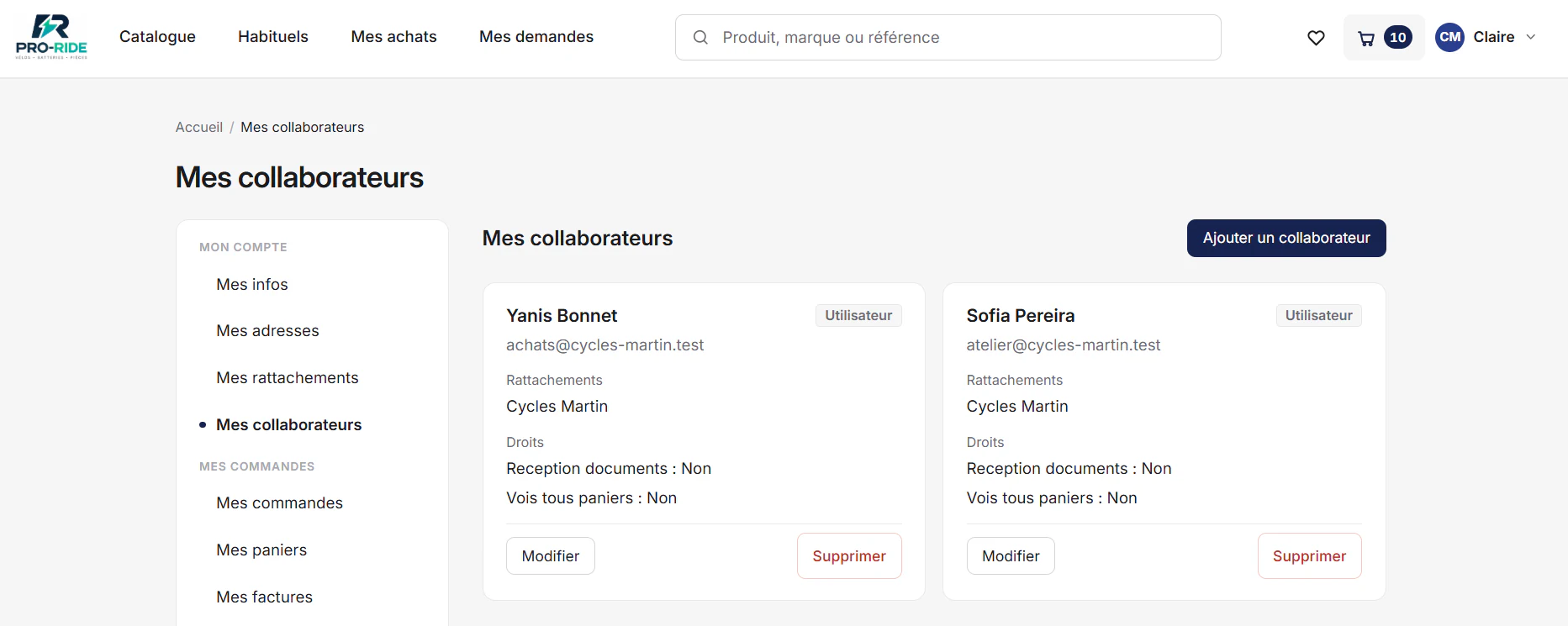
- Several users per customer, roles and permissions
- Segmentation, networks, profiles
- Accessible catalogues, prices and terms
- Preferences, usual products, relationship history
Example: a team member prepares a basket without being able to approve it; a manager receives it and places the order. The level of permissions is tailored to the project.
Documents and exchangesThe right document, in the right journey
- Quotes, orders, order acknowledgements, invoices, contracts
- Attachments linked to a deal, an order or a customer
- Making documents available, sharing and exchanging them with the customer
The DRM is not meant to replace a corporate document management system: if you have one, it remains the reference document system.
Operations and logisticsFrom order to delivery
- Order picking, multi-order picking, consolidation
- Picking and progress tracking, deal tracking
- Goods receipt for purchases
- Stock managed in the DRM, fed by the ERP or WMS, or a hybrid architecture
- Shipping cost rules engine: weight, volume, amount, destination, commercial rules
Carrier integrations, labels and parcel tracking are specific to each project: they depend on the carrier, its APIs, the WMS and your logistics process.
Sales force and assisted sellingThe sales rep on the same foundation as their customers
- Customer status and history, their prices, their usual products
- Current quotes and orders, tracking
- Creating a basket or an order for the customer
- Picking up a quote request
- Sales signals and follow-ups, automated according to the project’s rules
The DRM is not a sales route planning tool.
After-sales and customer serviceAfter-sales in the same place as orders
Centralise after-sales requests in the same area as orders and customer documents.
- Creating and qualifying a request
- Messages and attachments
- Tracking, status, visibility for the customer
- Simple handling of a warranty claim or replacement
This is not a specialist service management or advanced returns solution: complex after-sales processes are scoped project by project.
Customer relationship engagementTailor the experience to each profile
- Customer segmentation, content tailored to the profile
- Featured products, promotions
- Engagement by network, customer-specific news feed, events
- Emailing and notifications depending on the project
The DRM uses customer knowledge to drive engagement, without replacing a marketing automation platform where one is needed.
Signals, forecasts and managementWhat the relationship tells you
Orders, baskets, quotes, requests and recurrence are centralised. They let you monitor activity, spot unusual activity, detect a quote that went nowhere, observe recurrence, build sales forecasts and support the sales teams.
Dashboards adapt to your context. If you have a BI tool, it can remain your main analytics system.
IT systems integration and AILet each system do what it does best
APIs, web services, files, imports and exports, middleware, events, MCP: integration adapts to your context. See the architecture below.
The DRM can also be queried or driven by AI agents via the MCP protocol, exposing only the authorised data, functions and actions. For example: “Which customers requested a quote over €10,000 this week but haven’t ordered yet?”, then “Follow up with them and let me know if any of them replies.”
ERP, CRM and WMS integrationThe DRM can run on its own or integrate with your IT systems
Standalone, the DRM serves as the main foundation for customers, orders and operations. In a hybrid setup, it handles the customer experience and the necessary processes, while existing systems keep their role. The aim is not to create duplicates, but to let each system do what it does best.
| System | Its role | With the DRM |
|---|---|---|
| ERP | Management system of record | Exchanges items, customers, prices, stock, orders, invoices and statuses |
| CRM | Opportunities and sales activity | Complementary: the DRM handles the request, basket, quote and order |
| WMS | Logistics | Stock and picking native to the DRM, or synchronised with the WMS |
| PIM | Product data | Feeds the catalogue that the DRM publishes in each journey |
| DMS | Documents | Remains the reference; the DRM makes documents available in the right place |
| BI | Analytics | Remains the main analytics tool; the DRM supplies its signals |
| DRM | Customer experience, requests, sales | Operational orchestration, in direct contact with customers and teams |
ERP and Sage X3. Hi-perf has strong ERP expertise, particularly with Sage X3. The DRM then acts as the customer-facing and operational layer around the ERP: items, customers, prices, stock, orders, invoices, statuses, documents, availability. The product remains independent of the ERP.
DRM vs Shopify, PrestaShop, CRM or ERPWhy a DRM rather than stacking tools?
The DRM sits at the crossroads of B2B e-commerce (online selling between businesses), customer portals, CRM, customer service, order management and assisted selling. It is an architectural philosophy, not a judgement on other solutions.
E-commerce platforms
Shopify, PrestaShop, WooCommerce, Adobe Commerce, OroCommerce…
Excellent when the project is first and foremost a commerce project. The DRM becomes relevant when needs go beyond the online store: contract pricing, personalised catalogues, quotes, networks, complex products, operations, IT systems integration.
The question is not whether a store can sell, but how far your business has to bend to its model.
CRMs
Salesforce, HubSpot, Sellsy, Zoho…
Very effective for prospects, contacts, opportunities and the pipeline. The DRM focuses on demand, customer autonomy, the basket, the quote, the order, documents, operations and recurrence.
The two approaches are complementary.
Integrated ERPs
Odoo…
An integrated ERP aims to carry a large part of the IT systems in a single model. The DRM creates a strong customer-facing and operational layer, keeping the ERP and existing building blocks where they do their job.
A different strategy, not a better one in absolute terms.
Composable custom builds
Architecture assembled from building blocks
It can handle almost anything, at the cost of several technologies, interfaces and products, heavier governance and more demanding maintenance.
The DRM keeps the flexibility of custom development, on a shared product foundation.
Where the DRM is particularly relevant
SMEs and mid-sized companies · selling to trade customers, or to trade customers and consumers · manufacturing, distribution, brands, networks, groups · technical or configurable products · recurring orders · complex pricing · existing IT systems to keep · specific business processes.
Where a specialist solution may be preferable
Very standard consumer store · very advanced contact centre · pure WMS, PIM or DMS · pure CRM · replacing a full ERP · advanced marketing automation.
Custom B2B e-commerceWhen your business goes beyond the standard, your platform has to keep up
Complex rules, technical products, particular sales processes, networks, advanced permissions, specific operations, deep IT systems integration: this is where the DRM makes the difference. The order of priority is always the same:
- Configuration
- Shared foundation features
- Reuse
- Custom development, if it adds value
Custom development is integrated into the foundation in a controlled way, rather than scattered across a series of independent modules.
B2B customer portal costHow much does a DRM cost?
The DRM is offered only as SaaS, hosted in France by Hi-perf. It combines a setup (the implementation project), a monthly subscription that includes hosting and, where applicable, custom adaptations. The licence is unlimited; the subscription is indexed to the business volume generated through the DRM.
Entry prices, to give you a sense of the offer. Your price depends on your business volume and the scope of the setup; it is set once your needs have been scoped. Details on the Pricing page.
B2B customer portalFrequently asked questions
Can the DRM be installed on our own servers?
No. The DRM is offered only as SaaS: Hi-perf hosts it in France, runs it and maintains it. It then connects to your internal tools according to the agreed integration scope.
Do we need to replace our ERP or CRM?
No. The DRM can run on its own or connect to your ERP, CRM, WMS and other tools. It replaces only what needs replacing.
Can we sell to both consumers and businesses?
Yes. Each site published from the DRM has its own sales mode and price display: a consumer site with prices including VAT and a Pro area with prices excluding VAT can coexist on the same foundation.
Can a team member prepare an order without approving it?
Yes. A team member can prepare a basket without having permission to approve it; a manager receives it and places the order. Permissions adapt to each customer’s organisation.
Does the DRM connect to marketplaces and carriers?
It can, but these are specific scopes, assessed case by case according to the APIs, each platform’s rules and your organisation.
Can orders be scheduled automatically?
Not as standard. However, customers can reorder a basket or a past order in a few clicks and find their usual products.
Your customers go where things are easy. Make sure that’s with you.
What the customer wants to do, what the sales rep needs to know, what the company has to execute, what the IT systems must record: that is Demand Relationship Management.