
Selling technical or configurable products onlineHow to digitise the sale of technical or configurable products
When customers need to know a voltage, a capacity, a connector type or a compatibility before they can buy, online sales stall. Yet most of these questions have a structured answer.
To sell a technical or configurable product online, you need to guide the customer to the right variant (specifications, versions, compatibility) and provide a way out for anything that can’t be priced in advance: a quote request within the same journey. The customer orders standard items on their own; the sales rep prices whatever requires their expertise.
Variants, compatibility, optionsThe situation: the product exists, but buying it is complicated
Spare parts, batteries, components, equipment with options: in many catalogues, the same product comes in several versions. To choose, the customer needs technical information they don’t always have to hand:
- the capacity, voltage, size or generation;
- the right connector or power supply type for their country;
- compatibility with the equipment they already own;
- whether an option or customisation is feasible.
Without a clear answer, they send an email, wait, chase it up. Or they buy from whoever made it easier for them.
Why consultative selling resists going digital
Selling technical products has always relied on advice: a sales rep or technician who asks the right questions and points to the right part number. That advice has value. But much of the back-and-forth involves repetitive questions whose answers are already in the product specifications.
The aim is not to do away with advice. It is to automate what can be automated so that the sales rep can focus on the advice that really adds value.
What online stores can do
E-commerce solutions handle simple variants (size, colour) and rich product pages well. Visual configurators also exist for certain sectors.
Product pages and standard configuratorsWhere the limits appear
The limits show when the choice depends on context (the customer’s equipment, their country, their use case), when some options can’t be priced in advance, or when the buyer is a business with its own terms. The store then forces a choice between two bad options: put everything online and risk errors, or send customers to a contact form that takes them out of the journey.
From the right product to the quoteHow it should work
- The customer describes their need
- They find the compatible products
- They choose the right version
- They order, or request a quote
- The sales rep prices the custom part
Finding the compatible batteryA practical example
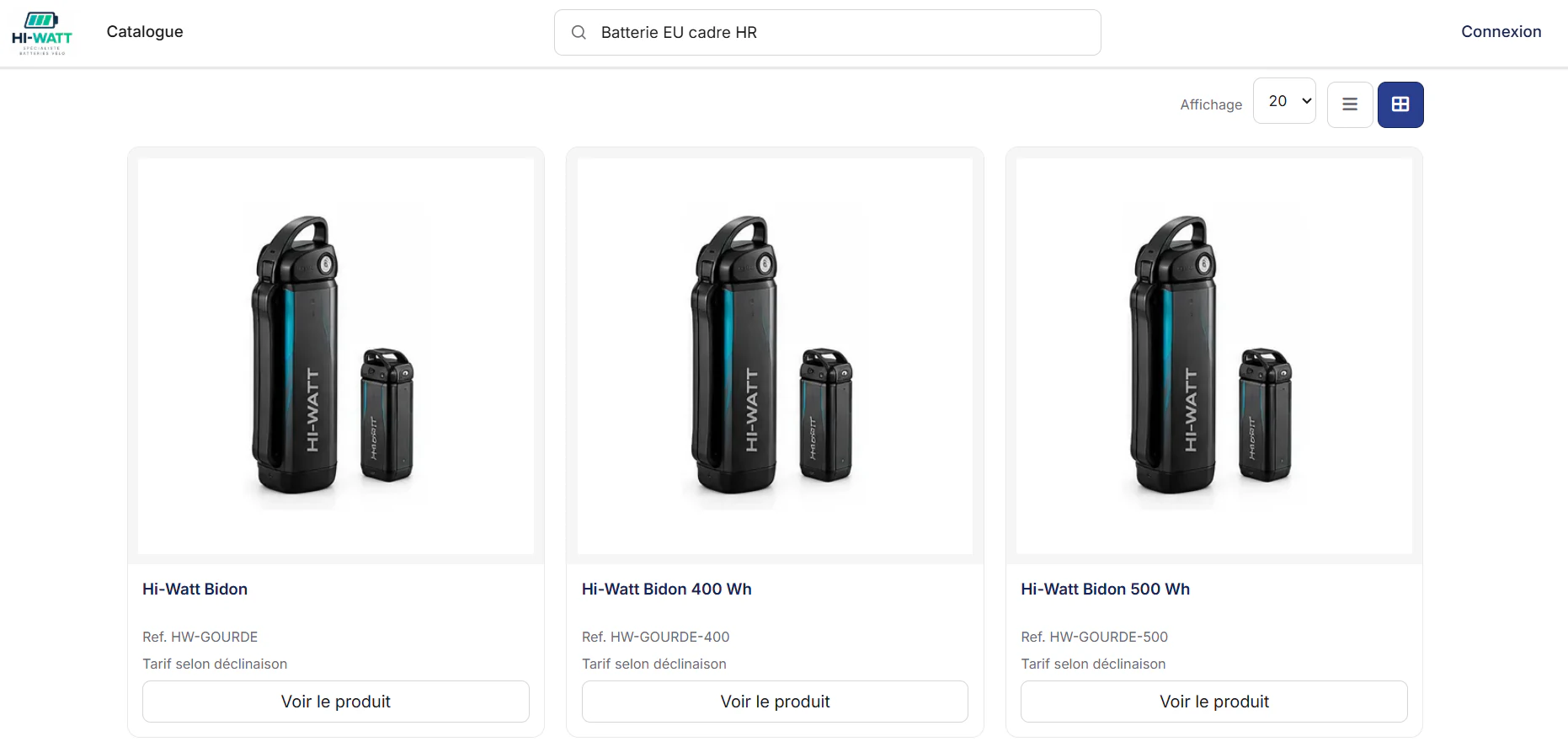
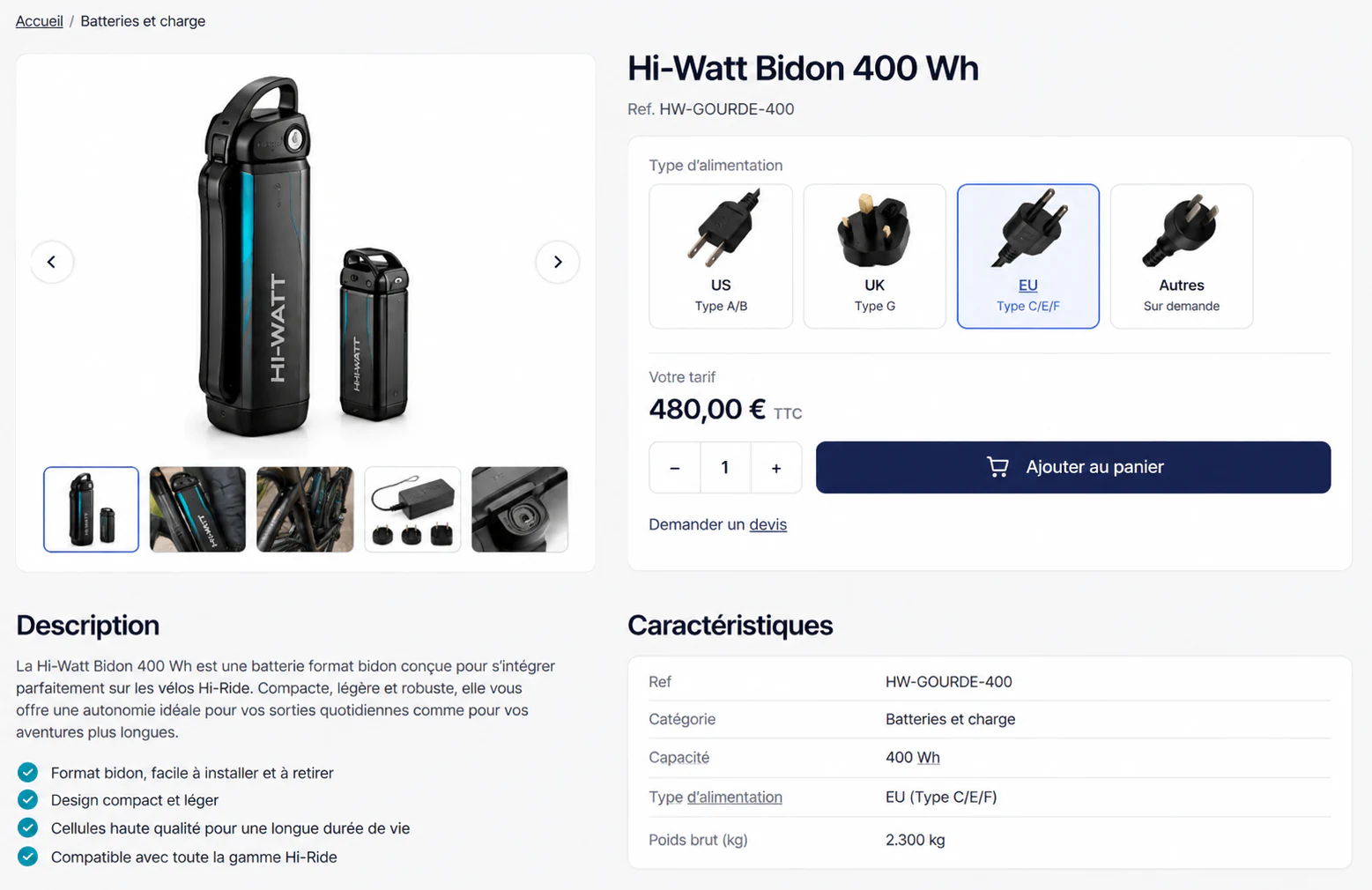
In our demonstration, Claire, who runs a bike shop, needs to replace the battery on a customer’s e-bike. In her supplier’s catalogue, she searches for a battery suited to the frame and the European market: the DRM shows her the compatible batteries, each with its part number. On the product page, she chooses the power supply type (US, UK, EU, or other on request) and finds the relevant specifications.
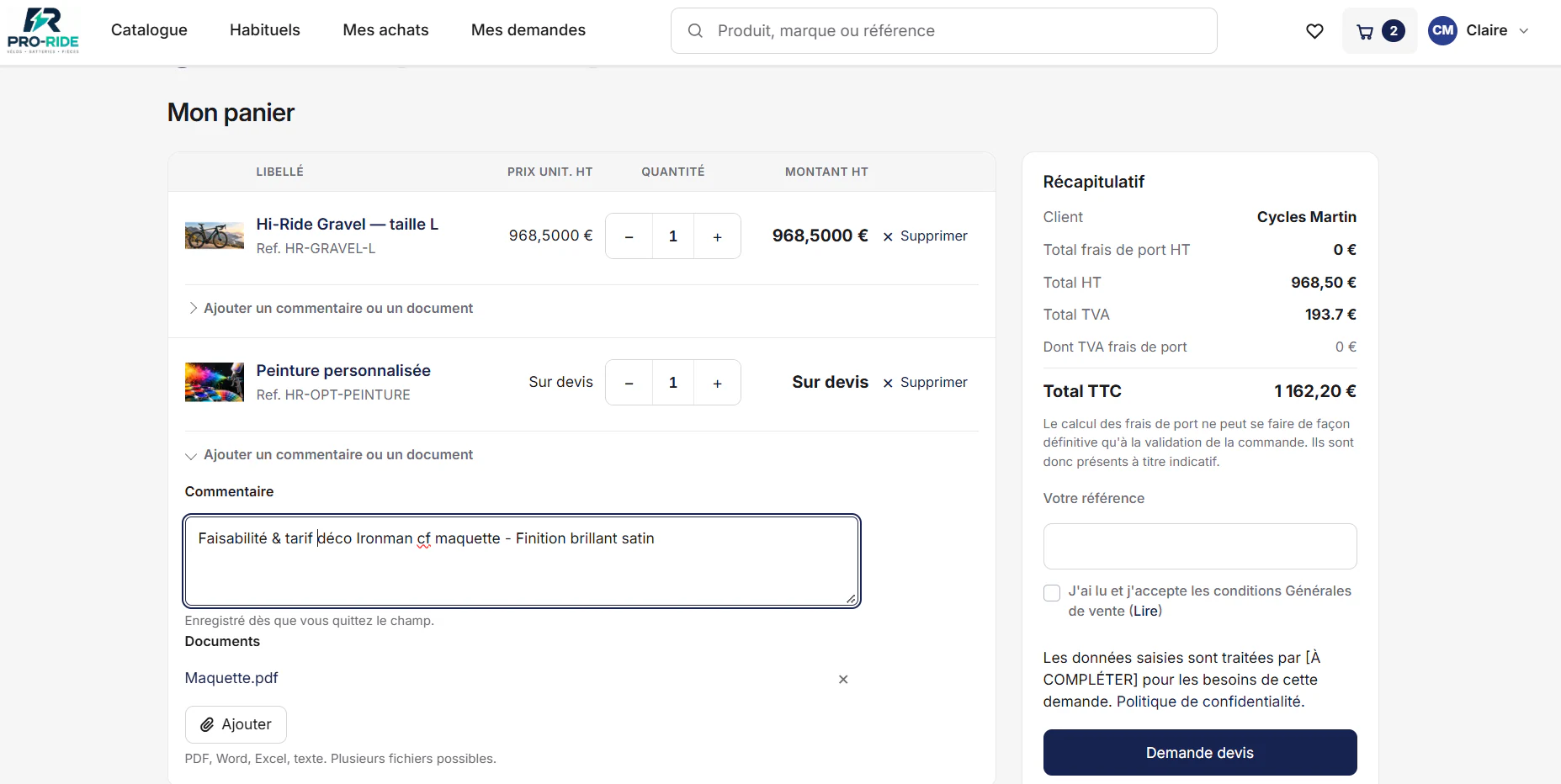
For another customer, Claire needs a custom paint job. This product has no catalogue price: it is “price on request”. She still adds it to her basket, describes the request in a comment and attaches the mock-up. At head office, the sales rep receives the complete request, prices the customisation and sends the quote.
Variants, compatibility and online quotesWhat the DRM brings
- VersionsThe same item in several versions, each with its specifications.
- Effective searchBy product, brand or part number.
- “Price on request” linesWith a comment and attached documents: PDF, Word, Excel…
- A quote just a click awayFrom the product page or from the basket.
- A well-informed sales repThey receive the complete request, price it and send back the quote.
- The customer’s own termsApplied to what they order as well as to what they ask to have priced.
The DRM does not replace a 3D configurator. It organises what matters for selling: finding the right product, and handling custom requests without taking the customer out of the journey. See all the DRM features.
Product data, PIM and ERPIntegration and constraints
The quality of buying guidance depends on the quality of the product data: specifications, versions, compatibility. This data often already exists, scattered across the ERP, technical files and the team’s know-how. Structuring it is the first job, and it is something Hi-perf regularly works on with its customers: data, ERP, exchanges between systems.
Selling technical productsFrequently asked questions
Can standard products and price-on-request products be mixed in the same order?
Yes. The basket can contain lines at catalogue price and price-on-request lines. It then becomes a quote request that the sales rep handles as a whole.
Can the customer attach a drawing or a mock-up?
Yes. Each basket line accepts a comment and documents (PDF, Word, Excel, text), passed on to the sales rep with the request.
Do you need a visual configurator?
Not necessarily. For many technical products, a sound structure of versions and compatibility, supplemented by quotes for custom requests, covers most of the need.
Are your customers torn between three part numbers?
Let’s talk about your catalogue and your custom requests. We’ll show you how the DRM can guide your customers.